
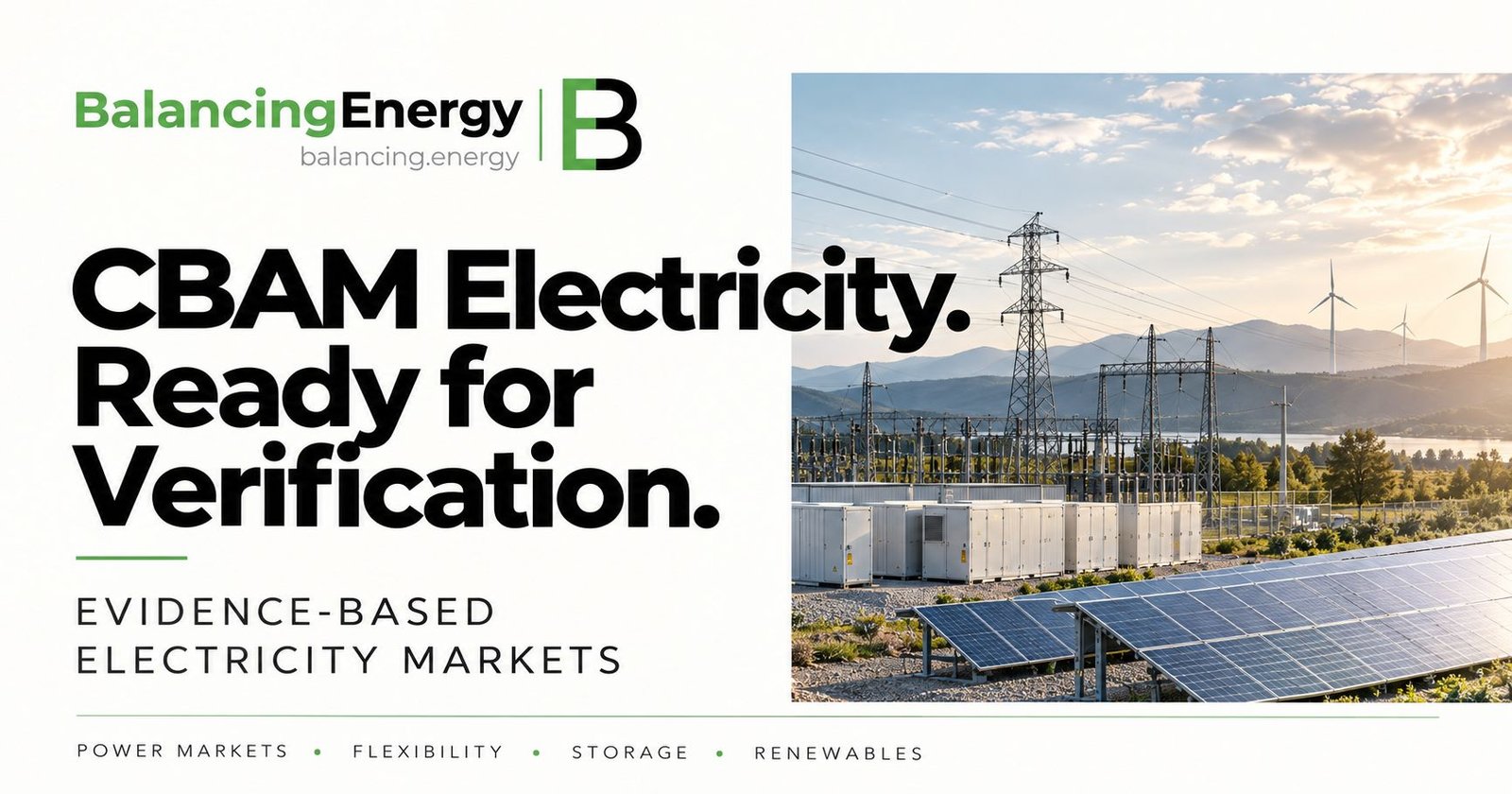
Serbia’s next clean-energy opportunity is no longer limited to building individual renewable projects. The more strategic opportunity sits between wind generation, solar generation, battery storage, industrial electricity demand, export competitiveness and verified carbon documentation. A platform built around 100 MW wind, 100 MW solar and 100 MW battery storage can create a practical bridge between renewable energy development in Serbia and the growing need of industrial exporters to prove the carbon quality of their electricity supply.
The commercial idea is straightforward. A renewable electricity producer should not only sell megawatt-hours into the market or sign a conventional corporate PPA. It can develop a structured green electricity platform that combines generation, storage, flexibility, metering, verification and carbon documentation. In this model, batteries are not simply technical equipment. They are the infrastructure that makes renewable electricity more reliable, more financeable, more traceable and more valuable to industrial customers producing for EU-linked supply chains.
This platform is particularly relevant for Chinese and European industrial clients operating in Serbia, including manufacturers, mines, metals processors, steel users, copper and aluminium producers, automotive suppliers, building-materials producers, data centres and other energy-intensive export businesses. These clients increasingly need electricity strategies that go beyond price. They need reliable supply, reduced exposure to grid volatility, better documentation of electricity origin and a credible route toward CBAM-ready products.
The model combines front-of-the-meter and behind-the-meter storage. The FTM BESS is connected to the grid and operates as a market-facing flexibility asset. It can support balancing, day-ahead and intraday optimisation, congestion management, ancillary services, renewable portfolio smoothing and negative-price capture. The BTM BESS sits inside an industrial facility, mine, factory, data centre or processing site. It optimises customer load, cuts peak demand, increases self-consumption, improves resilience and provides stronger evidence that renewable electricity is being used in the production process.
The strength of the platform comes from combining these layers. Wind provides high-volume renewable generation, often with stronger evening and seasonal output. Solar provides daytime generation that can support industrial consumption and charge batteries during low-price or high-output periods. Battery storage creates flexibility, firmness and dispatch control. Industrial offtakers create contracted demand. The verification framework turns electricity flows into auditable evidence for product-level carbon reporting. Together, these elements form a stronger commercial product than a standalone wind farm, standalone solar park or standalone battery could offer on its own.
The first case study is a 100 MW wind project. In Serbian conditions, a bankable wind asset of this size would typically be assessed around an annual generation envelope of roughly 250–330 GWh, depending on wind resource, turbine selection, hub height, terrain complexity, availability, wake losses, grid curtailment and final energy-yield assessment. The indicative CAPEX range may sit around €125 million–€165 million, subject to turbine procurement, grid connection scope, roads, foundations, substation works, owner’s costs, development costs and financing conditions. The bankability case depends not only on the wind resource, but also on grid access, balancing exposure, offtake structure, construction risk, EPC wrap, turbine warranty, availability guarantees and the ability to monetise the green electricity value with industrial buyers.
A 100 MW wind project can become the anchor of a verified green electricity platform because it produces a meaningful volume of renewable energy that can support industrial PPAs. However, wind output is variable, and a plain wind PPA may leave both producer and customer exposed to imbalance, shape risk and delivery mismatch. A battery-backed structure changes that position. It allows part of the wind output to be shaped, firmed or allocated more intelligently to customers with real production schedules. For the wind owner, that can support a higher-value offtake strategy. For the industrial customer, it creates a stronger electricity supply product than a generic annual renewable certificate.
The second case study is a 100 MW BESS project, developed either as a grid-facing FTM asset, a customer-side BTM asset, or a hybrid platform serving both market and industrial needs. A typical base configuration could be 100 MW / 200 MWh, with a longer-duration option of 100 MW / 400 MWh depending on the revenue stack, industrial load profile and grid-connection capacity. The indicative CAPEX range for a 100 MW / 200 MWh system may sit around €60 million–€95 million, while a 100 MW / 400 MWh configuration could require a materially higher investment envelope, depending on battery chemistry, EPC scope, grid works, fire-safety design, augmentation strategy, land, civil works and control systems.
The BESS case is the financial hinge of the platform. A pure merchant battery depends heavily on market spreads, balancing prices, cycling assumptions and dispatch optimisation. A pure BTM battery depends heavily on the host customer’s load profile, credit quality and tariff structure. A hybrid BESS platform can be stronger because it blends several value streams: renewable shaping, industrial peak shaving, backup resilience, time-of-use optimisation, imbalance reduction, ancillary services, negative-price capture and green electricity documentation. The lender model should therefore not treat the battery as a single-revenue asset. It should test contracted and merchant revenue separately, with conservative assumptions for degradation, availability, augmentation, round-trip efficiency, warranty limits and dispatch rights.
A 100 MW BESS can also serve as the bridge between renewable production and CBAM-ready industrial consumption. When connected at grid level, it can support portfolio-level optimisation for wind and solar assets. When installed behind the industrial meter, it can prove that the customer’s production process is using renewable electricity more effectively, not just buying claims on paper. This distinction matters. Industrial clients serving EU buyers will increasingly need credible evidence chains showing electricity procurement, metering, allocation and consumption. Battery data, SCADA records and settlement-period matching can become part of the documentation package.
The third case study is a 100 MW solar project. In Serbia, a project of this scale may generate approximately 125–155 GWh per year depending on irradiation, module technology, tracker use, inverter design, DC/AC ratio, degradation, soiling, grid curtailment and site-specific losses. The indicative CAPEX range may sit around €55 million–€80 million, subject to land preparation, modules, inverters, mounting systems, grid connection, permitting, owner’s costs and financing conditions. Solar is attractive because it is modular, relatively fast to build and highly compatible with industrial daytime load. Its weakness is also obvious: production is concentrated in daylight hours and may increasingly coincide with low-price or negative-price periods as regional solar penetration grows.
That weakness becomes an opportunity when solar is integrated with storage and industrial offtake. A 100 MW solar project can supply daytime load directly, charge BTM batteries inside industrial sites, support self-consumption structures and reduce the customer’s exposure to peak tariff periods. When paired with a grid-facing battery, solar output can be shifted into evening demand periods or used to support a more predictable supply profile for industrial buyers. The combination of solar and storage is particularly relevant for factories, logistics facilities, data centres, processing plants and industrial parks with stable daytime demand.
Taken together, the three case studies show the logic of the platform. The 100 MW wind project provides volume and stronger seasonal output. The 100 MW solar project provides daytime renewable supply and fast-build capacity. The 100 MW BESS project provides flexibility, firming, optimisation and documentation support. The industrial client provides demand, contract visibility and strategic value through export-market positioning. The result is a green electricity product that can be structured for bankability, not just marketed as a sustainability claim.
The FEED approach is central to making this work. The project should not start with equipment selection. It should start with a commercial and technical diagnosis of what the platform needs to achieve. The right question is not simply whether to build wind, solar or batteries. The right question is what combination of renewable generation, storage duration, grid interface, customer load, metering architecture, dispatch logic and verification evidence creates the strongest bankable product for Serbia’s industrial exporters.
For the wind case, FEED must address turbine selection, yield assessment, grid connection, terrain constraints, transport logistics, foundation design, SCADA integration, forecasting, curtailment, balancing responsibility and PPA shape risk. It must also test whether storage should be co-located, virtually allocated or developed separately as a portfolio asset. A technically strong wind project can still face financing pressure if its route to market is weak, its balancing exposure is underestimated or its grid assumptions are not lender-grade.
For the BESS case, FEED must define the business model before the battery size is locked. A 100 MW / 200 MWhsystem may be optimal for high-frequency cycling, short-duration flexibility and peak management. A 100 MW / 400 MWh system may be more suitable for longer shifting, industrial resilience and deeper renewable firming. The technical design must cover battery chemistry, containers, PCS, transformers, fire-safety systems, HVAC, EMS, SCADA, grid-code compliance, metering, warranty restrictions, degradation management and augmentation timing. The financial model must separate contracted revenue from merchant upside and test downside scenarios where market spreads compress or cycling is lower than expected.
For the solar case, FEED must test the site, grid capacity, land status, permitting route, irradiation assumptions, panel technology, inverter loading ratio, tracker economics, grid export limits, curtailment exposure and storage interface. Solar becomes more valuable when its production is linked to a real industrial load rather than left fully exposed to midday market cannibalisation. A solar project with a credible BTM or FTM storage interface can support a stronger offtake proposition, especially when the customer needs evidence of renewable electricity use during production hours.
For Chinese and European industrial clients in Serbia, the combined model offers more than electricity procurement. It offers a route to CBAM-ready production positioning. An exporter that can show structured renewable supply, battery-backed optimisation, metered consumption, documented allocation and disciplined energy management will have a stronger case with EU customers, banks and supply-chain partners. This does not eliminate all carbon exposure, because product-level emissions depend on the full production process. But it gives the company a stronger and more credible electricity component in its embedded-emissions narrative.
The bankability model should therefore be built around both energy value and documentation value. For lenders, the core questions are clear. What share of revenue is contracted? What share is merchant? How strong is the industrial offtaker? What happens if market spreads fall? What happens if battery degradation is faster than expected? What happens if the grid connection is delayed? What happens if curtailment rises? What happens if the customer terminates or reduces load? What DSCR is maintained under downside assumptions? What is the minimum contracted revenue required to support debt service? What reserve accounts, guarantees, step-in rights and technical covenants are needed?
A serious lender frame should include CAPEX, OPEX, debt sizing, DSCR, LLCR, equity IRR, merchant capture, contracted offtake, battery augmentation, availability, degradation, curtailment, grid delay, connection cost, PPA pricing, industrial tariff savings, CBAM documentation value, customer credit risk and EPC performance exposure. It should also include a live risk register covering permitting, grid connection, environmental approvals, fire safety, technology warranty, SCADA integration, metering, data governance, industrial load risk and compliance documentation.
The contractual architecture is just as important as the technical design. The wind and solar projects may sell power through corporate PPAs, green electricity supply agreements or portfolio allocation structures. The BESS may be contracted through tolling, capacity reservation, savings-sharing, availability payments, balancing services or hybrid merchant arrangements. The industrial customer may buy energy, flexibility, documentation services or a combined green electricity product. The strongest structure will likely blend a base contracted revenue layer with carefully controlled merchant upside, rather than rely entirely on spot-market capture.
Environmental and ESG integration must be part of the platform from the beginning. Wind projects require biodiversity screening, noise assessment, shadow flicker analysis, land-use review, access-road planning and construction monitoring. Solar projects require land, drainage, biodiversity, waste, panel lifecycle and grid-impact assessment. Battery projects require fire-risk planning, hazardous-material procedures, emergency-response protocols, recycling strategy, noise review, permitting alignment and occupational-safety controls. Industrial clients will also need a credible governance system for green electricity claims, metering records, audit trails and ESG reporting.
This is where Clarion.Engineer’s service model is strongest. The platform requires engineers who understand wind, solar, batteries, grid connection, SCADA, metering, commissioning and industrial operations. It also requires advisors who understand lender covenants, debt sizing, DSCR, offtake credit, EPC risk, CBAM exposure, ESG expectations and export-market pressure. The value is created by integrating these disciplines early, before the project becomes locked into a weak technical or commercial structure.
Clarion.Engineer can support the platform through pre-FEED and FEED structuring, renewable and BESS development advisory, technical due diligence, grid-readiness review, industrial load analysis, BESS sizing, PPA and tolling architecture, CAPEX/OPEX modelling, lender dashboards, DSCR and IRR sensitivity, risk registers, environmental and ESG integration, CBAM-ready electricity documentation, SCADA and metering requirements, commissioning-readiness planning and owner’s engineer supervision during procurement, construction and energisation.
The commercial proposition is not simply 100 MW wind, 100 MW solar and 100 MW battery storage. It is a verified industrial energy platform designed to make Serbian renewable electricity more valuable, more financeable and more relevant to export-oriented production. Wind provides volume. Solar provides daytime supply. Batteries provide flexibility. Industrial clients provide contracted demand. CBAM creates the export-market rationale. FEED converts the idea into a bankable project architecture.
Elevated by Clarion.Engineer — The engineers that speak finance.